

The Convergence of Payments Modernization and AI
- Posted by appcentrica
- On June 20, 2026
- 0 Comments
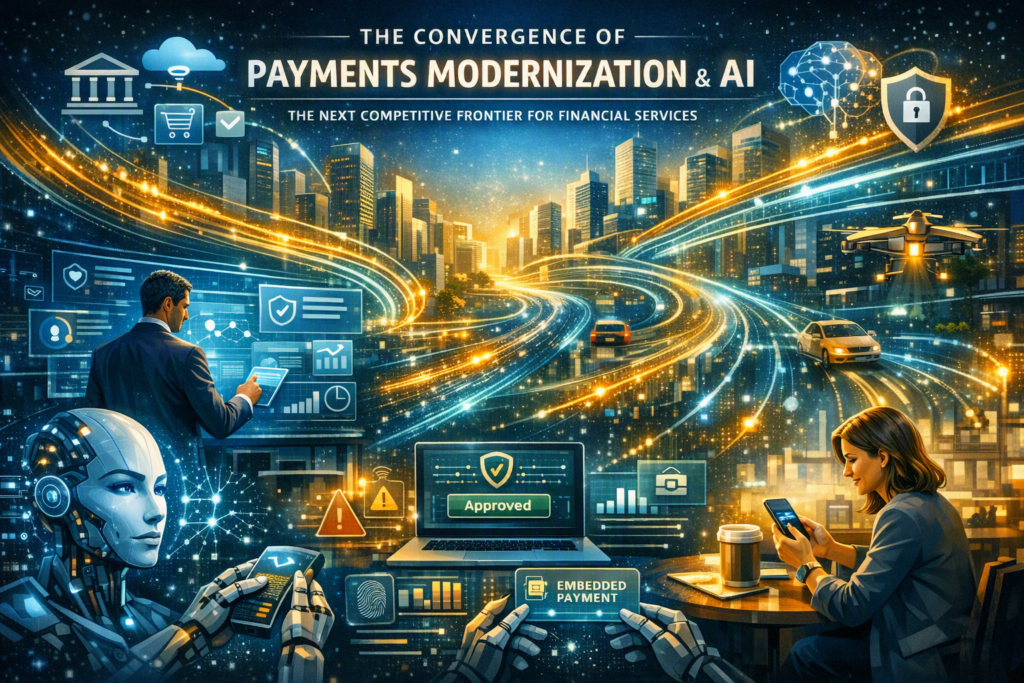
The Convergence of Payments Modernization and AI: The Next Competitive Frontier for Financial Services
The payments industry is entering one of the most significant periods of transformation in decades.
For years, payments modernization has focused on improving infrastructure: faster settlement, better connectivity, stronger security, open APIs, real-time capabilities, and richer data exchange.
At the same time, artificial intelligence has evolved from an experimental technology into a powerful business capability capable of automating decisions, optimizing processes, and transforming customer interactions.
The next major shift will occur when these two forces converge.
Payments modernization will provide the digital foundation. AI will provide the intelligence layer. Together, they will fundamentally change how financial institutions operate, compete, and serve customers.
Payments Will Become More Intelligent
Traditional payments have largely been transaction-based:
A customer initiates a payment.
A financial institution processes the payment.
A network clears and settles the transaction.
The future payments ecosystem will be different.
AI-enabled payments will increasingly understand context:
- Who is making the payment?
- Why is the payment occurring?
- Is the transaction normal?
- Is there a better financial option?
- Does this payment create a risk or opportunity?
Payments will move from being a simple financial transaction to becoming an intelligent financial interaction.
Imagine a business payment platform that recognizes cash flow pressures, predicts upcoming obligations, identifies opportunities to optimize liquidity, and recommends actions before a problem occurs.
That is not simply faster payments.
That is intelligent financial management.
Real-Time Payments + AI Creates New Operating Models
Real-time payment capabilities are often discussed as a customer experience improvement.
However, the bigger impact may be operational.
When payments move instantly, traditional batch-based processes become less relevant:
- End-of-day reconciliation
- Manual exception handling
- Delayed fraud review
- Slow operational reporting
- Reactive customer support
AI can redesign these processes.
Payment operations teams will increasingly work alongside AI agents that:
- Investigate payment exceptions
- Detect unusual transaction patterns
- Recommend fraud decisions
- Automate reconciliation
- Monitor operational risks
- Generate management insights
The future payment organization will not simply process more transactions.
It will manage intelligent payment ecosystems.
Fraud Prevention Will Shift From Detection to Prediction
Today, many fraud systems rely on rules, historical patterns, and transaction scoring.
These approaches remain important, but AI introduces a new capability: understanding complex patterns across massive amounts of data.
AI can help financial institutions identify:
- Emerging fraud networks
- Behavioral changes
- Account takeover signals
- Suspicious payment journeys
- Coordinated attacks
The goal will shift from:
“Was this transaction fraudulent?”
to:
“Is this payment behavior consistent with what we understand about this customer, business, or ecosystem?”
This creates the opportunity for better protection with fewer unnecessary declines.
A frictionless payment experience and stronger security no longer need to be competing objectives.
The Rise of Embedded and Invisible Payments
Modern consumers increasingly expect financial services to appear where they already conduct business.
This is accelerating the growth of:
- Embedded payments
- Embedded lending
- Embedded banking
- Digital wallets
- Platform-based financial services
AI will accelerate this evolution.
Instead of customers navigating banking products, intelligent systems will increasingly anticipate needs and deliver financial services within context.
A small business platform may identify a working capital need and recommend financing.
A commerce platform may optimize payment methods automatically.
A consumer app may provide personalized financial guidance at the point of decision.
The competitive question will become:
“Where does banking happen?”
The answer increasingly will be:
“Everywhere.”
Banks Must Rethink Their Technology Strategy
Many institutions have approached payments modernization as a technology replacement exercise.
That view is too narrow.
The opportunity is business transformation.
Modern payments capabilities require institutions to rethink:
Operating Models
Legacy processes built around manual intervention and batch processing will struggle in a real-time world.
Data Strategy
AI effectiveness depends on access to high-quality, connected data.
Payments generate some of the richest behavioral and financial data available.
Partnership Models
Open APIs and embedded finance will require banks to collaborate with technology companies, fintechs, and industry platforms.
Talent Models
The future payments workforce will combine human expertise with AI-enabled digital workers.
Employees will increasingly focus on judgment, relationship management, exception management, and strategic decisions.
AI will handle repetitive analysis and operational execution.
The Strategic Question for Financial Institutions
The question is no longer:
“How do we modernize payments?”
The more important question is:
“How do we redesign financial services now that payments can move instantly and intelligence can be embedded everywhere?”
The winners will not simply have faster payment rails.
They will have intelligent payment ecosystems.
They will combine:
- Modern infrastructure
- Real-time capabilities
- AI-powered decisioning
- Strong risk controls
- Customer-centric experiences
Payments modernization created the highway.
AI is creating the intelligence that will determine where the traffic flows.
The future of banking will belong to institutions that understand both.
0 Comments